
Data Center & Disaster Recovery
We design and build DC and DR setups that keep critical systems running through power, hardware, network, site and ransomware failures, with recovery times agreed in advance and proven in regular drills.
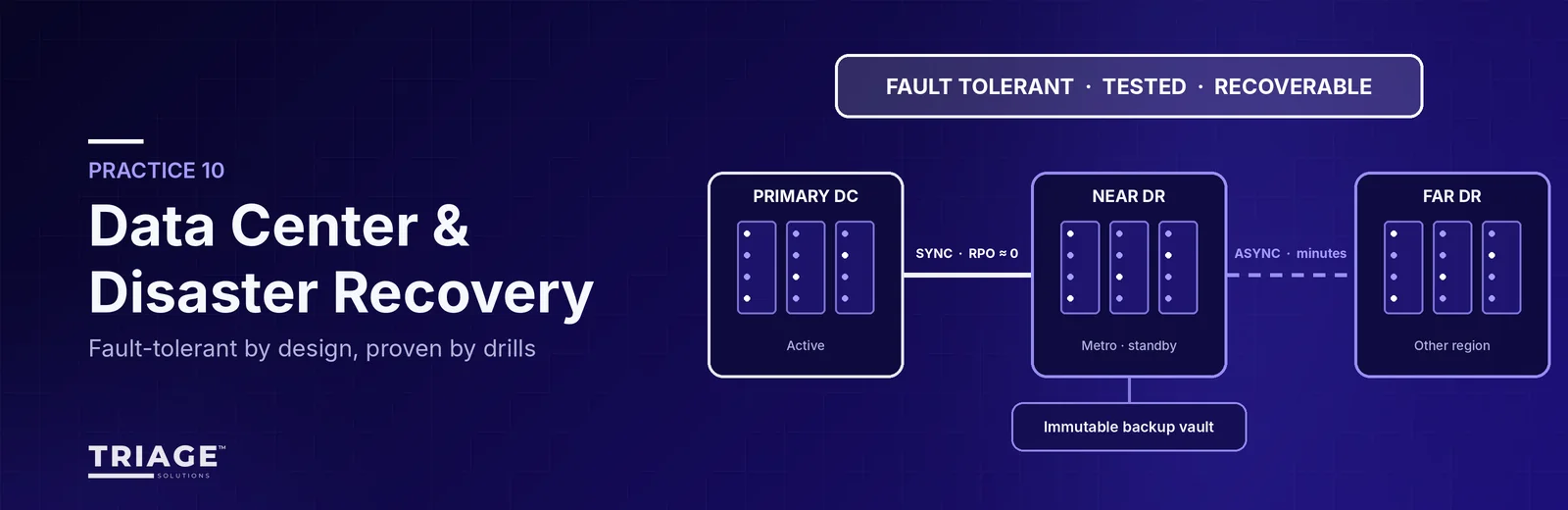
Fault-tolerant by design, proven by drills.
Downtime now stops revenue, customer service and, in regulated sectors, compliance. Banks, insurers, market intermediaries and hospitals are expected to show regulators a tested business-continuity plan, not just a backup policy. Ransomware has also changed the problem: recovery has to work even when the attacker has reached the primary site and its backups.
- Recovery times agreed and met in drills
- No single point of failure in power, network, compute or storage
- Clean recovery even after a ransomware attack
- Audit-ready evidence for RBI, SEBI and IRDAI reviews
Capabilities in this practice.
Business impact analysis
We rank every application by the cost of downtime and data loss, then agree a recovery time (RTO) and recovery point (RPO) for each tier with the business.
DC and DR architecture
Two-site or three-site designs, from backup-and-restore to active-active, matched to each tier's RTO and RPO instead of one costly design for everything.
Replication and data protection
Synchronous replication within a metro, asynchronous replication across regions, database-level replication, snapshots and immutable, air-gapped backups.
Network and traffic failover
Dual carriers, BGP, SD-WAN, global server load balancing and DNS failover, so users reach the surviving site automatically.
Runbooks and orchestration
Step-by-step recovery runbooks, automated failover and failback, and dependency maps that start systems in the right order.
DR drills and DR as a service
Planned switchover drills with evidence for auditors, plus continuous replication monitoring and recovery under SLA.
A clear path from goal to outcome.
Assess impact
Tier & target
Design
Build & replicate
Drill
Operate
RPO and RTO, agreed in advance.
Every DR design starts with two business decisions for each system. The recovery point objective (RPO) is how much data you can afford to lose, measured back from the moment of failure. The recovery time objective (RTO) is how long the service can be down before the damage is unacceptable.
Tighter targets cost more, so we set them tier by tier. Core banking may need an RPO of zero and an RTO of minutes; an internal wiki can accept hours. Matching the design to each tier is how we deliver strong resilience without overspending.
A three-site design for critical systems.
A near DR site in the same metro gives zero data loss through synchronous replication. A far DR site in another seismic zone protects against regional disasters. An immutable vault keeps a clean copy that ransomware cannot touch.
The right pattern for each tier.
We rarely put everything on the most expensive design. Each application gets the pattern that meets its RTO and RPO at the lowest sensible cost.
No single point of failure.
A system is only as resilient as its weakest layer. We design redundancy into every one, then test each failure on purpose.
Power
Dual utility feeds, 2N or N+1 UPS, diesel generators with fuel contracts, and dual-corded servers on separate power paths.
Network
Two carriers on diverse routes, BGP, redundant core and firewalls, SD-WAN for branches and plants, and DNS or GSLB failover.
Compute
Clustered hosts with N+1 capacity, automatic VM and container restart, and anti-affinity so replicas never share a failure.
Storage
RAID and erasure coding, synchronous replication within a metro, asynchronous replication across regions, and snapshots.
Databases
Oracle Data Guard, SQL Server Always On, PostgreSQL with Patroni and MySQL group replication for consistent, fast failover.
Applications
Stateless services, health checks, load balancers and queues, so applications reconnect cleanly after a failover.
Security and identity
Replicated directory and keys, MFA for administrators, and an immutable, air-gapped backup copy that ransomware cannot reach.
Operations
Monitoring of replication lag, runbooks, automated failover order, and drills that prove the plan works.
From impact analysis to proven recovery.
Business impact analysis
Interviews with each function to measure the cost of downtime and data loss, ranked into recovery tiers.
RTO and RPO targets
Recovery time and recovery point agreed per tier, signed off by the business, not just IT.
Architecture and sites
The right pattern per tier, site selection (near DR within a metro, far DR in another seismic zone) and capacity sizing.
Build and replicate
Network, compute, storage and database replication set up, with initial synchronisation and data-integrity checks.
Runbooks and automation
Dependency maps, start-up order, scripted failover and failback, and clear roles for every person in a disaster.
Drill, evidence, repeat
Planned switchover drills, measured RTO and RPO against targets, and a report for management and regulators.
Every engagement ends with a planned switchover drill. We fail over live systems in a controlled window, measure the RTO and RPO actually achieved against the targets, fail back, and hand you a report that management, auditors and regulators can review. After that, we repeat drills on a schedule and monitor replication every day, so the setup still works a year later.
Banks, NBFCs, insurers, brokers and market intermediaries, hospitals, manufacturers, high-traffic digital platforms and any business where an hour of downtime has a real cost.
A lender runs core banking from one data center with nightly tape backups. We set up a three-site design: synchronous replication to a near DR site in the same metro, asynchronous replication to a far DR site in another seismic zone, and an immutable backup vault, with switchover drills every quarter.
How we have delivered this.
Three-site DC and DR for core banking
A lender ran core banking, payments and internet banking from a single data center, with nightly backups to tape. A power or …
See what we did 02 HealthcareRansomware-proof recovery for a hospital network
A hospital group depended on its hospital information system, imaging (PACS) and lab systems around the clock. Its backups sat on the …
See what we did 03 Venues & eventsActive-active portal for peak-event traffic
A large venue's ticketing and visitor portal had to stay online through major events, when traffic jumps many times above normal. It …
See what we did 04 ManufacturingFault-tolerant plant systems that survive WAN loss
A manufacturer's plants depended on ERP and MES hosted at head office. When the WAN link dropped, production lines could not book …
See what we didReady to move fast on AI, without losing control?
Start with a free discovery session. We'll map your priorities, risks and quick wins, and come back with a clear plan.